01/04/2026 – How circular metals support decarbonization
Sustainable copper for wire applications
Copper is indispensable for wire and cable applications. As companies across the supply chain pursue increasingly ambitious sustainability targets, the demand for 100% recycled, low-carbon copper is rising and has become a strategic lever for materials sourcing. Requirements for environmental protection and CO2 footprint reduction are steadily growing, both among end users and throughout the upstream value chain.
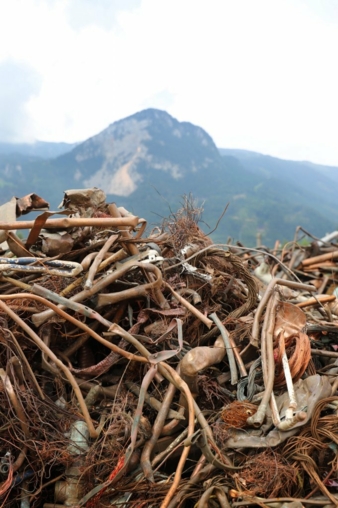
Copper scrap marks the starting point of circular metallurgy, serving as a valuable secondary raw material that enables environmentally friendly copper production while conserving natural resources. © Montanwerke Brixlegg
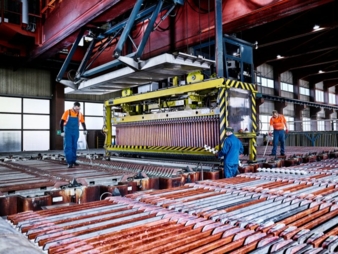
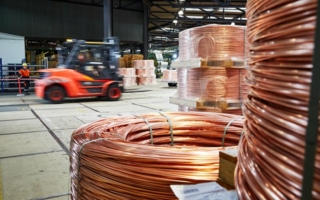
The tank house marks the final step in the copper recycling process. Through electrolysis, high quality cathodes are produced that reliably meet the requirements of demanding wire and cable applications. © Montanwerke Brixlegg
Copper produced from secondary raw materials offers uncompromising material quality with a significantly reduced environmental impact. Thanks to advanced recycling and refining methods, recycled copper today can meet the technical requirements of even the most demanding applications. At the same time, it helps conserve resources and drive the further development of a circular economy.
Copper at the beginning of a decarbonised supply chain
Wire and cable products are fundamental enablers of electrification, digitalisation, and the energy transition. While downstream applications often receive the most attention, the embedded carbon footprint and the recycled content of these products are largely defined at the very beginning of the value chain: copper production.
Not only OEMs at the end of the supply chain are increasingly setting ambitious sustainability and Scope-3 emission targets. These requirements are cascading upstream, reshaping material choices long before final assembly. In this context, copper is no longer a commodity alone, but a strategic input material with a critical environmental impact.
Circular copper without compromise
Copper is one of the few metals that can be infinitely recycled without quality loss, a real circularity champion.
Wire applications demand uncompromising material quality. Electrical conductivity, purity, drawability, and long-term reliability are non-negotiable. Copper cathodes produced entirely from recycled input streams can meet these requirements when supported by deep metallurgical expertise and tightly controlled refining processes.
At Montanwerke Brixlegg, copper has been produced exclusively from secondary raw materials for decades. Through advanced upcycling processes, post-consumer and post-industrial scrap is transformed into high-purity copper cathodes suitable for demanding wire applications. The resulting material matches the technical performance of primary copper while fundamentally reducing environmental impact.
Sustainability as a measurable and verified material property
Sustainability must be quantifiable and credible. Environmental performance is no longer based on declarations alone, but on independently verified data that can be integrated into product LCAs, sustainability reporting, and customer communication.
Montanwerke Brixlegg’s copper cathodes combine 100% recycled content with a Product Carbon Footprint of 629 kg CO2e per ton of copper (cradle-to-exit-gate). Both key sustainability parameters are independently third-party verified. The recycled content is certified by SCS Global Services, while the Product Carbon Footprint is verified by TÜV SÜD according to DIN EN ISO 14067.
From circularity to supply chain resilience
Beyond carbon reduction, circular copper offers further advantages: supply security, regulatory compliance, and risk mitigation. A sourcing model based entirely on recycled materials eliminates mining-related environmental and social risks and increases transparency across the upstream supply chain.
Copper for the next generation of wire applications
As the wire industry evolves, sustainability and performance are converging rather than competing. Copper produced through circular metallurgy demonstrates that high-quality wire applications and ambitious sustainability targets can be achieved simultaneously.
The author is Steffen Rieger.
wire 2026, hall 15 booth J 10
Montanwerke Brixlegg AG
Werkstrasse 1
6230 Brixlegg/Austria
Tel.: +43 676 846 899 668
steffen.rieger@montanwerke-brixlegg.com
www.montanwerke-brixlegg.com