17/07/2026 – EU research project
“Flex Cycle” automates cable recycling
The EU project “Flex Cycle” brings AI and robotics into cable recycling: over four years, autonomous systems are to learn how to recover metals such as copper in a targeted way from cable bundles. Complex cable bundles in the recycling stream.
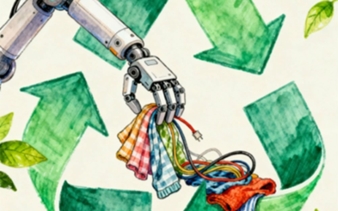
The EU project “Flex Cycle” brings AI and robotics into cable recycling. © FlexCycle
In cable recycling, cables often appear as tangled bundles, which makes targeted processing extremely difficult.
This is precisely where the European research project “Flex Cycle” (Flexible Robotic Automation Techniques for Soft Materials Recycling) comes in. With a budget of 7.5 million euros and twelve partners from six countries, the consortium aims over the next four years to make recycling processes for flexible materials such as cables, textiles and fuel cell membranes suitable for industrial application.
Isolating a target cable in the bundle
For the cable use case, “Flex Cycle” follows a clearly defined technical approach. The robotic systems must learn to orient themselves within tangled cable bundles, identify a target cable and isolate it in a controlled manner. In the next step, insulating layers are to be removed automatically so that the contained metals, in particular copper, can be recovered. The basis for this is the combination of flexible robotic tools as end-effectors with AI-based modelling, which is defined in the project as the central technological approach.
Three application fields, one technology module
Alongside cables, “Flex Cycle” addresses two further application fields. In the PEM fuel cell use case, the focus is on the safe, automated extraction of sensitive flexible membranes that contain health-hazardous substances and on the recovery of catalyst materials containing precious metals. In the textile use case, AI systems are trained to detect features such as seams so that accessories including buttons and zips can be removed, allowing the fabric from garments to be recovered.
Demonstrators and consortium
Overall, the technological concept of “Flex Cycle” is based on adaptive hardware and software components that are intended to be transferable to different industrial sectors. For all three use cases – textiles, cables and fuel cells – demonstrators will be developed over the four-year project period to demonstrate the practical suitability of the autonomous systems.
The project is coordinated by the Istituto Italiano di Tecnologia and funded under the Horizon Europe programme. The consortium includes, alongside the Fraunhofer IWKS and Fraunhofer LBF institutes, the Jozef Stefan Institute, the University of Göttingen, the Technical University of Munich, Vytautas Magnus University, qb robotics Srl, Electrocycling GmbH, Symbio SAS and OSIT Impresa S.p.A.
Fraunhofer-Institut für Betriebsfestigkeit und Systemzuverlässigkeit LBF
Bartningstraße 47, 64289 Darmstadt/Germany
Tel.: +49 6151 705-268
anke.zeidler-finsel@lbf.fraunnhofer.de
www.lbf.fraunhofer.de