06/04/2026 – Wire processing
Versatility and performance in perfection
The demands on the performance and versatile application of products are continuously increasing. Customers require components for guiding, straightening, and feeding that meet the needs of various process materials and cross-sectional geometries, ensure a wide processing range, and permanently withstand high forces and moments.
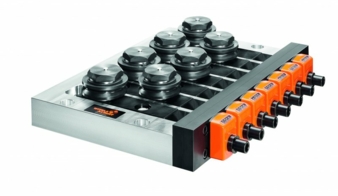
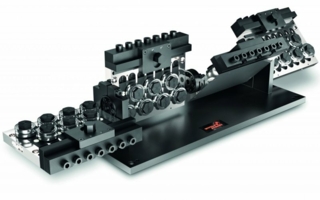
„Mega Power – Multi Purpose” straightening unit “MP 7-15 PO 3/4” for straightening various process materials within a huge straightening range. © Witels-Albert
Using their calculation, simulation, and design tools, they have succeeded in developing new straightening units that, like many other products from Witels-Albert GmbH, have no equivalent worldwide.
For the elastic-plastic deformation of the process material, seven straightening rollers are used, arranged alternately offset in two roller rows. In the “MP 7-15 3/4 PO” model, the 3-roller row on the operating side is assigned to the two head strips, which are equipped with mechanical position displays PO for the defined and reproducible adjustment of the straightening rollers. The 4-roller row is located behind or below the process material, depending on the installation position of the straightening unit. The “MP 7-15 4/3 PO” model uses the 4-roller row on the operating side for the straightening process.
Using the 3/4 and 4/3 versions uniformly or mixed in a straightening system consisting of two straightening units in the direction of the process material flow allows the realisation of a total of 16 straightening system construction variants. It is recommended to design and apply a suitable straightening system for a specific application in such a way that the axis of the first straightening roller arranged in the transport direction of the process material is parallel to the axis of, for example, an upstream coil or deflecting roller, and both axes are located on the same side relative to the centreline. Instead of an upstream coil or deflecting roller, process material curved in an adequate manner can be relevant.
If this is taken into account, the version of the outgoing straightening unit of the exemplary straightening system can be uniform with the version of the incoming straightening unit if the goal is to produce straight process material. If, however, the goal is to produce defined curved process material, the version of the outgoing straightening unit is determined by the desired orientation of the residual curvature, which can be concave or convex relative to the axis orientation of the outgoing straightening unit and is generally adjusted by the operating personnel using the second-to-last adjustable straightening roller of the outgoing straightening unit.
The newly developed dual-head bar design of both models ensures precise support of the roller adjustment spindles and, with the highest rigidity, reliably absorbs the forces transmitted via the straightening rollers and slides to the spindles. The roller adjustment is carried out via a fine thread, which enables low-backlash and precise fine adjustment of the tools for deforming the process material. The individual roller adjustment torque without load is preset at the factory and can be adapted by the customer for each slide or adjustment mechanism. Specific elements in the force flow ensure lubrication and prevent welding under high loads or high surface pressure.
This makes it possible for the relubricatable high-performance straightening rollers GB 80 SL to withstand roller forces that occur during the processing of 15mm round wire according to the standards EN 10270-1 (hard-drawn spring steel wire, grade DH) and EN 10270-2 (oil-tempered wire, grade FDC). In addition, non-corrosion spring steel wires, which are generally available up to 10 mm in accordance with EN 10270-3, can be processed, e.g., austenitic steel 1.4301 (EN 10088, AISI 304).
The straightening range of the straightening units “MP 7-15 3/4 PO” and “MP 7-15 4/3 PO” is determined to be from 4 mm to 15 mm. In addition to wire-shaped process materials, profile wires, tubes, or multi-wire process materials can be processed within the aforementioned straightening range. If necessary, under or exceeding the straightening range for all process materials is possible, but in such cases, a suitability test must be carried out by Witels-Albert.
The series designation “MP” of the new straightening machines stands for “Mega Power – Multi Purpose” and is deliberately chosen because the versions and the straightening range of the “MP” models allow the achievement of various objectives regarding straightness or residual curvature and represent 5 standard straightening ranges of Witels-Albert. For machine manufacturers, this significantly simplifies the design of the assembly required for the straightening sub-process. The conversion of processing machines or lines is thus not required or less frequently. The operating personnel will benefit from using only one familiar and high-performance model, possibly in different versions, for processing many process materials.
wire 2026, hall 9 booth E 39
Witels-Albert GmbH
Malteserstrasse 151-159
12277 Berlin/Germany
Tel.: +49 30 72398811
info@witels-albert.com
www.witels-albert.com