28/09/2026 – 75 years WIRE - Wire processing / Straightening
Our tomorrow
For more than seven decades, Witels-Albert has been fascinated by the roller straightening process, which motivates the Berlin-based company to design components for its cost-effective and sustainable implementation.
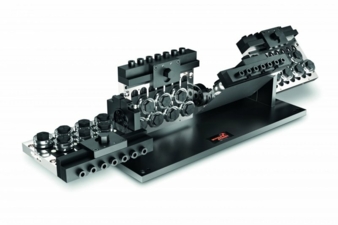
Best-selling straightening system fitted with ‘RTS’ units. © Witels-Albert
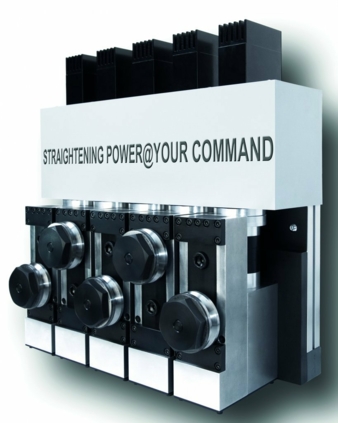
‘CS EASY’ straightening technology with actuators and sensors. © Witels-Albert
The range of materials to be processed, cross-sections and dimensions, the variety of delivery conditions for the process materials, and the diversity of finished parts have come together to form a modular product range that is popular with customers both at home and abroad. Customers appreciate the advantage of being able to use standardised products for straightening processes, which ensure a high degree of flexibility whilst significantly reducing procurement, installation and maintenance costs.
In 1946, Walter Wittig, a master mechanical engineer from Berlin, began manufacturing small batches of straightening devic-es as a representative of one of the founding branches of Witels-Albert; under his successor, Eckehard Albert, this was quickly followed by the production of large series. Over the years, the product range has been expanded to include further components such as roller guides, feeding units and even complete straightening machines, which use components manu-factured in-house.
With regard to the roller straightening process, product design, following the development phase, goes through the stages of optimisation, dynamisation and integration, which are determined by the use of elements such as position indicators, actua-tors and sensors for adjusting the straightening rollers. Defined and reproducible roller positioning is regarded as a key fea-ture for the efficient execution of the roller straightening process. The method for the automated control of a straightening process was patented in 1996 and assessed for its strengths and weaknesses. However, given the investment costs required on the part of customers and specific challenges that could not be adequately resolved, products enabling the automated control of the straightening process failed to gain a foothold in the market.
With the inline wire diagnosis, a technical derivative of the 1996 patent application entered practical operation in 2012. In collaboration with NV Bekaert SA, the system is being used to continuously monitor changes in a wire’s technical yield point on a dry drawing machine. The concept is based on the identification of the wire diameter, accompanied by the measurement of a roller force and relevant mechanical principles of the model of the relevant mechanical laws of the model of the three-fold statically undefined bend, which are assumed to be valid for the deformation process carried out using a diagnosis device. Long before Industry 4.0 became a topic of discussion, Witels-Albert was already contributing to the continuous assess-ment and adjustment of wire product quality. The continuous availability of information on changes in wire diameter and the technical yield point allows for the creation of a new value system for classifying wire quality, centred on the ongoing deter-mination of the consistency of these properties and the associated technical and economic aspects. Projects in this field highlight the conflicting interests that exist within the industry in this regard. Wire manufacturers find it difficult to identify and provide information that allows for a comprehensive assessment of wire quality. Processors, on the other hand, would like to see evidence of wire quality that goes beyond the limited snapshot data provided by tensile tests carried out at the beginning and/or end of the wire. With efforts towards ongoing digitalisation and the objective of having to produce and utilise high-quality products, there will be further developments in in-line wire diagnostics. This will certainly resolve the current tension between these conflicting requirements.
The simulation of the roller straightening process, developed in the mid-1990s, enables reliable predictions to be made re-garding the required roller set points, roller forces and transport forces. At Witels-Albert, process simulation is used to evaluate existing straightening processes and to design new ones. Agility at the interface between suppliers and product users, as well as the product developments of recent decades, would not have been possible without process simulation, particularly when taking into account the principles of ‘Design to Cost’ and ‘Time to Market’. This efficiency is reflected in the SimDATA (2001) and How2Straight (2018) service offerings. Using these tools, customers can plan the straightening process as part of work preparation and communicate clear instructions to operating staff regarding the adjustment of roller straight-ening devices.
Achieving the higher-level system as the next stage in the product design of straightening devices remains the objective. The next step is defined by its integration into machine and plant control systems, accompanied by the implementation of a knowledge-based concept for presetting roller positions. Approaches for assistance systems for presetting straightening devices are available on the market and will be widely used in practice in the future. Witels-Albert is actively supporting developments in this field.
Witels-Albert GmbH
Malteserstrasse 151-159
12277 Berlin/Germany
Ansprechpartner ist Marcus Paech
Tel.: +49 30 723988-0
info@witels-albert.com
www.witels-albert.com