02/10/2026 – Wire drawing / tools
Synthetic diamond products and tools from one source
Since 2007, Redies has been offering synthetic diamond products under the “MANT” brand name. Customers benefit greatly from the fact that materials science expertise and die production are housed under one roof.
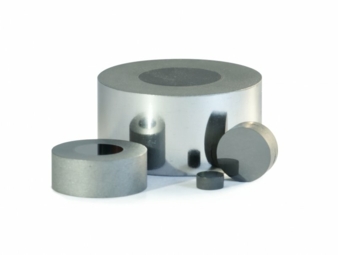
PCD blanks of different sizes, self-supported and with tungsten carbide ring. © Redies
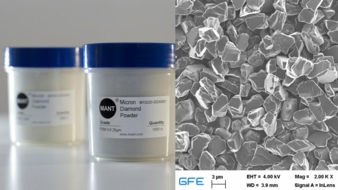
left: diamond powder container, right: SEM image of top quality 5µm diamond powder for PCD synthesis. © Redies
Redies is a manufacturer of drawing dies and specialised machinery. Over time, its capacity and capabilities have been expanded. The entire process chain is now fully covered – from product development to procurement and analysis of raw materials, closely controlled synthesis processes, die production and final inspection prior to dispatch to the customer.
Diamond forms naturally under enormous pressure and at very high temperatures. Since the 1950s, processes have been developed to technically replicate these conditions in order to synthesise diamond. This feat of engineering became known by the acronym HPHT process (High Pressure – High Temperature). These processes made it possible, for the first time, to synthesise single crystals and polycrystalline diamonds (PCD) measuring several centimetres in size. PCD in particular, which is quasi-isotropic, is an ideal drawing die material for a wide range of applications, including round wire drawing dies, sliding dies, bunching dies, and profile dies.
In the 1990s, detonation synthesis was introduced. This process produces nano- and microscale diamond powders. These can be processed and used as high-quality abrasives and polishing agents. These powders are also suitable as feedstock for PCD synthesis. In this case, very fine grading is required following grinding and chemical treatment. The shape of the grains plays an important role here, which is why the so-called morphology of the powder must be checked using scanning electron microscopy.
There is another, entirely different process that also enables the synthesis of single-crystal diamonds of impressive size. In this process, diamond is deposited atom by atom onto a substrate from a carbon-containing gas mixture. The umbrella term CVD (Chemical Vapour Deposition) encompasses this process alongside other applications in semiconductor technology, coating technology and similar fields. These processes also require high temperatures and are distinguished by the type of reactor heating used.
Two variants have become established for the synthesis of diamond. Firstly, the method known as HF-CVD (HF standing for Hot Filament). This utilises resistance heating using tungsten filaments. Nitrogen is added to slow down corrosion of the heating elements caused by hydrogen. Nitrogen has a similar atomic size to carbon, precipitates in the diamond and hinders defect-free synthesis. In addition to possible defects, the resulting characteristic yellow colour of the diamond is particularly noticeable to the naked eye.
Pure diamonds of exceptional quality can be produced using the second method, which utilises external microwave heating. This is therefore known as MP-CVD (MP standing for Microwave Plasma). No nitrogen necessary. The <111> crystal orientation, which is optimal for round drawing dies, can be ensured using both methods.
Synthetic single-crystal diamonds are commonly referred to as SSCDs (Synthetic Single Crystal Diamonds). As far as the material itself is concerned, SSCDs differ from natural diamonds only in their external form, if at all. In both cases, the crystal lattice consists of carbon atoms. As described, their manufacturing process produces crystals of statistically higher purity and thus more reliable drawing tools.
Further strong arguments in their favour are the price advantage and, not least, their traceable, conflict-free origin. There are currently geopolitical hurdles; the leading miners of natural diamonds are Russia and countries in Africa. Against this backdrop, SSCDs offer significant advantages even for users subject to the EU Supply Chain Due Diligence Act.
The author Ferdinand Kießling ist managing director of Redies Deutschland GmbH.
Redies Deutschland GmbH
Metzgerstrasse 1
52070 Aachen/Germany
Tel.: +49 241 504-222
info.de@redies.com
www.redies.com