17/09/2026 – 75 years WIRE – “That was tomorrow”
Stranding technology between vision and production readiness
When the first issue of WIRE was published in 1951, design work in Magdeburg was still carried out using slide rules, drafting boards, and empirical data. Seventy-five years later, we simulate vertical stranding machines with a total mass of over 3,000 metric tons using FEM before the first chip is cut.
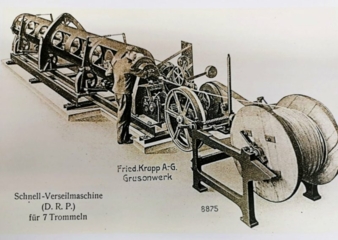
Pipe stranding machine, circa 1920. SKET VMB GmbH © SKET VMB
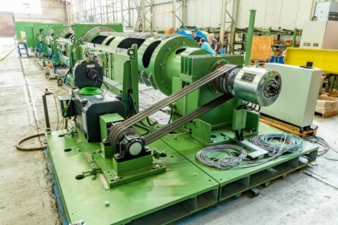
Modern pipe stranding machine. © SKET VMB
What lies in between is not a series of revolutions, but the consistent translation of visions into robust machine technology. A look back at what we imagined as “tomorrow” – and what actually came of it.
History: 150 years of mechanical engineering, 30 years under its own name
The roots of SKET Verseilmaschinenbau GmbH date back to 1855, when Hermann Gruson founded his machine factory in Magdeburg-Buckau – which later became part of Friedrich Krupp AG Grusonwerk. In 1953, the Krupp-Gruson/SMAG machine factory gave rise to the VEB Schwermaschinenbau “Ernst Thälmann”; this was followed in 1969 by the formation of a combine, whose acronym remains the basis for the company’s name to this day. On January 3, 1997, SKET Verseilmaschinenbau GmbH was founded as an independent company and is part of the Wilms Group.
Today, approximately 130 dedicated employees work on a 40,000m² company site with over 10,000m² of production and assembly space. To date, the company has made deliveries to over 35 countries on five continents.
“That Was Tomorrow” –
Four predictions and their reality check
1. Prediction:
“Central stranding will replace the basket machine.” Result: Partially Fulfilled
When SKET delivered the first “MKZ” (Central Strander) machine in 1974, the idea was considered risky: Feeding individual wires from stationary spools instead of rotating cages, with stranding via a central rotor. Further developed to series production readiness in the 1980s, the MKZ system has permanently transformed the production of copper and aluminum conductor cables: shorter setup times, lower inertia, significantly higher availability, and rapid stranding speeds.
Market penetration has been achieved – the 100th “MKZ” machine was delivered in 2024. What has not happened is the replacement of the cage strander: for sector conductors, large conductor cross-sections, and insulated wires, the Rigid Strander (MKD) remains technically irreplaceable. The prediction of success was correct, though not in all areas of stranding technology – a pattern that frequently repeats itself in this field.
2. Prediction: “Cables are going into the sea.” Result: Exceeded
The idea of building stranding machines for submarine cables on a scale more reminiscent of shipbuilding than mechanical engineering was still a niche topic in the 1990s. In 2008, following an order from NSW Nordenham, the “MKVD 3x4250+6x2800+9x1250” – at that time the world’s largest basket-type stranding machine – was delivered. In 2012, the first vertical stranding machine, the “MVD”, was added for stranding three insulated round conductors into long subsea cables. The total input for this machine amounts to approximately 2,500 metric tons of cable and other stranding elements.
Offshore expansion has not only confirmed this development but has surpassed it. HVDC subsea cables, dynamic cables for floating wind farms, and intercontinental interconnectors now place demands on processing volumes, tensile force control, and the length of error-free production sections that were considered uneconomical 20 years ago.
3. Prediction: “It doesn’t get any bigger than this.” Result: Disproved
Two figures suffice: in 2013, SKET delivered the “SRW 1+48x800”, the world’s longest pipe stranding machine; in 2014, it delivered the “WT5600/600” winder with a 640-metric-ton capacity and a 10-meter coil width. Both projects pushed the practical upper limit of what was considered manufacturable – a limit now constrained less by stranding technology than by the customer’s overhead crane capacities, foundations, and transportation logistics.
4. Prediction: “The machine is replaced every 15 years.” Result: Clearly refuted
Perhaps the most glaring misforecast in the industry. To this day, rope and cable mills worldwide operate machines that are 40 to 50 years old and continue to produce reliably in compliance with standards. Instead of replacement, retrofitting is also a viable option.
What basic physics does not change
Despite all digitalization, the key parameters of stranding technology remain unchanged: lay length and lay direction, degree of back-twist, wire tensile force and its uniform distribution across all pay-off points, centrifugal force on the stranding basket, cyclic bending stress, and residual twist in the final product. What has changed is controllability:
– Drive technology: from transmission shafts (König shafts) to DC drives to fully electronically synchronized individual drives. Stranding length changes are now made by calling up a recipe, not via a gearbox.
– Tensile force control: controlled coil brakes and drives instead of manually adjusted friction brakes – a prerequisite for uniform stranding geometry with both high-strength and very soft materials alike.
– Design: FEM analysis instead of safety margins. This allows for lighter, stiffer designs at higher speeds – and is also a prerequisite for sound retrofit decisions on older machines
– Safety: Risk assessment in accordance with the Machinery Directive is now an integral part of every retrofit, not just an appendix.
Looking ahead: our “tomorrow” for 2035
So that the WIRE editorial team can hold us to account in a future issue, here are three specific expectations:
– Predictive maintenance will become the standard, not an option. Vibration and temperature monitoring of rotor, pipe, and roller bearings provides advance warning, leading to planned downtime rather than breakdowns. The benefits are obvious for machines operating at high capacity – the hurdle is data sovereignty for the operator, not the sensor technology.
– Retrofitting will become a sustainability decision. A machine made of cast iron and steel incorporates a significant amount of embodied energy. Those who continue to use it for 50 years instead of recasting it will, in the future, no longer argue solely about the investment cost, but about the plant’s carbon footprint.
– Aluminum and composite conductors continue to gain ground. Grid expansion, HVDC, and weight requirements in overhead line construction are shifting the mix of materials. For stranding machines, this means: tighter tensile strength windows, more precise wire guidance, and more custom-built machines instead of off-the-shelf products.
What we do not expect: that software will replace the strander. Setting a strand to zero residual twist remains a matter of experience at the machine – digitalization makes this experience reproducible; it does not replace it.
Closing remarks
75 years of WIRE and roughly 170 years of mechanical engineering in Magdeburg have led to a shared insight: “Tomorrow” rarely turns out exactly as predicted. For decades, WIRE has provided our industry with a platform for dialogue, both in German-speaking countries and internationally. We congratulate them on this – and look forward to reading more.
SKET Verseilmaschinenbau GmbH
Schönebecker Strasse 82-84
39104 Magdeburg/Germany
Contact person is Kathrin Scheibe
Tel.: +49 391 405580
info@sketvmb.de
www.sketvmb.de