17/03/2026 – Joint-assisted cutting for high-strength heavy springs
Mechanical leverage over motor power
The “YT-140” design prioritises effective force transmission over raw power delivery. By leveraging mechanical geometry rather than electrical capacity, the system achieves optimised cutting performance while maintaining controlled load behaviour under high-strength cutting conditions
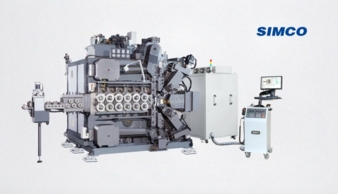
Joint-assisted cutting for high-strength heavy springs. © Simco
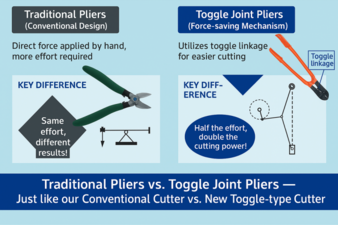
Toggle design concept. © Simco
Over the past decade, the tensile strength of spring wire has increased steadily across automotive, industrial, and energy-related applications. Materials once considered difficult to process are now becoming baseline specifications. While forming accuracy and production speed often dominate discussions in spring manufacturing, cutting performance is increasingly defining the true operational limits of heavy spring forming machines.
As wire strength rises, cutting systems — long treated as secondary mechanisms — are exposed as critical bottlenecks. Stability, vibration, tool life, and machine longevity are now directly influenced by how cutting force is generated and transmitted. Under these conditions, simply increasing motor power is no longer a sustainable solution.
This article examines a joint-assisted cutting concept that has been implemented on the “YT-140” platform. The performance data presented is based on a direct comparison between a conventional 20mm spring coiler and the “YT-140” under identical cutting conditions, illustrating how mechanical leverage and force distribution can address high-strength material cutting more effectively than conventional motor upsizing.
The limits of power-centric cutting
Historically, heavy spring cutting systems have relied on a straightforward assumption: higher material resistance requires higher motor output. While energetically valid, this approach introduces fundamental drawbacks in real production environments.
Increasing motor power amplifies shock loads during cutting, intensifies vibration, and accelerates fatigue across shafts, bearings, and cutting tools. Motors operate closer to thermal and torque limits, while tool wear becomes less predictable. Over time, cutting shifts from a simple process step to a constraint on stability and long-term machine reliability. The underlying issue is not the availability of power, but how efficiently that power is converted into usable cutting force at the blade.
Mechanical geometry as an alternative
Rather than asking how much power a machine can deliver, the “YT-140” design began by questioning how effectively cutting force is transmitted to the material. The solution emerged from mechanical geometry rather than electrical capacity. Inspired by the difference between simple pliers and toggle-joint cutters, the joint-assisted cutting mechanism amplifies force through leverage rather than raw output. Cutting advantage is created not by increasing input energy, but by establishing a more favourable force-displacement relationship at the cutting point. In this design philosophy, efficiency is achieved structurally, not electrically.
Joint-assisted cutting design
At the core of the “YT-140” platform is a joint-assisted (toggle-type) cutting geometry that converts motor motion into a balanced, leveraged cutting action.
During the cutting phase, force is distributed through two joint paths, with each joint carrying approximately half of the total load. This load-sharing arrangement reduces peak stress concentrations and moderates impact forces, resulting in smoother motion and improved system stability.
From an engineering perspective, the reduction in peak load directly improves fatigue life across the cutting mechanism.
Peak motor load under cutting conditions
Measured motor load data highlights the difference between power-driven and mechanically optimised cutting systems.
Under idle cutting cycles, a conventional 20 mm spring coiler operates at approximately 126% motor load, while the joint-assisted “YT-140” remains at ~120%. During actual high-strength wire cutting, peak motor load rises to 172.6% on the conventional system but is limited to ~134.7% on the “YT-140” equipped with joint-assisted cutting.
From idle to cutting, motor load increases by nearly 46% on the conventional system, compared to only ~14% on the joint-assisted system. This contrast reflects differences in force management rather than motor capacity.
These results show that joint-assisted cutting stabilises peak load during the cutting moment, reducing mechanical stress and improving long-term reliability.
Implications for motor sizing
Machines equipped with joint-assisted cutting achieve equivalent cutting performance using an 11.0 kW motor, compared to approximately 30.0 kW required in conventional cutting configurations.
This finding challenges a long-standing assumption in heavy spring manufacturing: that cutting capability is primarily determined by installed motor power. In practice, performance depends on how intelligently cutting force is delivered and controlled.
Extension to the “YT-250M” platform
Based on the validated performance of joint-assisted cutting on the “YT-140” platform, Simco is planning to extend this mechanical concept to the “YT-250M”, a next-generation 25mm heavy spring forming machine.
This progression reflects a deliberate engineering strategy aimed at addressing the increasing demands of high-strength, large-diameter spring materials, while maintaining system stability and long-term reliability.
Conclusion
As material strength continues to rise, cutting systems must evolve beyond power-centric thinking. The joint-assisted cutting concept demonstrates that mechanical leverage and force management can deliver measurable gains in stability, efficiency, and machine longevity. In heavy spring manufacturing, mechanical intelligence – not motor size – defines the next generation of cutting performance.
wire 2026, hall 16 booth A 01
Taiwan Simco Company
6F.-1, No.27, Ln. 61, Sec. 1, Guangfu Rd.,
Sanchong Dist., New Taipei City 24158/Taiwan
Tel.: +886 2 29954088
simco@simcotw.com
www.simcotw.com