06/10/2026 – Wire drawing / tools
A revolution in PCD die production technology
Traditional PCD die production technology relies on a sequential combination of laser processing (nano or picosecond laser) or electrical discharge machining (EDM) (which degrades the diamond and selectively burns cobalt from the binder) and multi-stage ultrasonic polishing or wire polishing, which is difficult to fully automate.
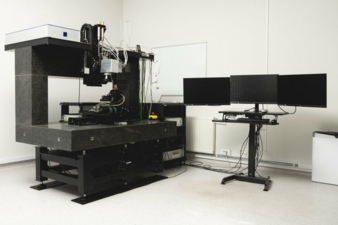
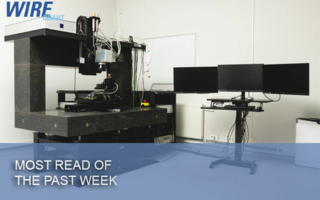
Photo of the research and development laboratory. Machine tool with a Femto laser. © Nota
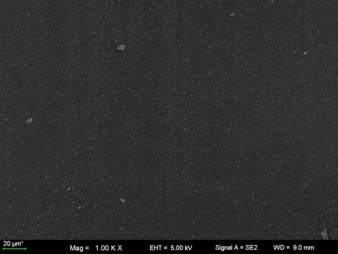
1um PCD diamond after femto laser processing. Field emission SEM microscope - ZEISS Ultra Plus, EDS detector Bruker eFlash124eV. © Nota
These methods are subject to wear errors in the forming tool (needle), leading to uncontrolled deviations in the working cone angle and rounding of the transition zone between the working cone and the calibrating part.
Based on its research and development work (patent pending), Nota utilized multi-axis femtosecond laser processing with a wavelength selected (in single-step mode) to generate the full 3D die geometry in a single setup, with a very high surface quality that requires no further processing. Eliminating mechanical contact guarantees perfectly sharp, repeatable geometry of the calibration zone and precise concentricity of all die zones, which directly minimizes shear stresses in the wire during drawing at high linear speeds.
The femtosecond laser processing process eliminates the phenomenon of diamond graphitization (i.e., the degradation of the hard diamond phase into soft graphite).
All dies produced using this method with a given diameter are identical, which is particularly desirable when drawing wire on multi-wire machines. Using PCD dies produced this way in wet drawing, especially at high speeds, generates direct, measurable technological and economic benefits.
– improved wire surface quality for the EV sector
– uniform, defect-free surface topography of the output wire
– extended tool life (reduced downtime).
The transition to completely dry, waste-free laser processing aligns with the Green Manufacturing strategy, drastically reducing the carbon footprint and chemical consumption during the tool production stage.
Nota Zaklad Mechaniki Precyzyjnej
Ul. Inzynierska 8L
20-484 Lublin/Poland
Contact person is Stanislaw Szymczyk
Tel.: +48 81 4441125
nota@nota.pl
www.nota.pl