26/03/2026 – Stranding
A digital brain for heavy-duty stranding
“Rigid Edge” was developed together with customers to address real concerns: Hesitation to increase speed, unstable quality and unexpected downtime. By embedding intelligence into production equipment, pneumatic rigid stranders evolve from brute forced machines into systems with refined control awareness. This moves production toward a data-driven future.
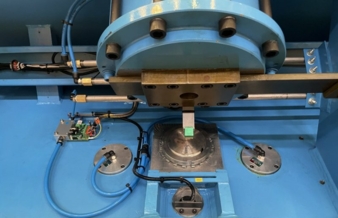
“Rigid Edge” pneumatic tension control on a rigid strander. © Pioneer
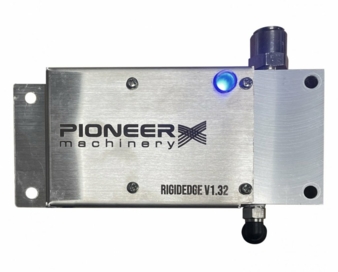
The core of “Rigid Edge” technology. © Pioneer
Most rigid stranders use pneumatic disc-brake tension control. Compressed air from a central pressure regulator is sent to each reel brake. The friction from the brake slows the bobbin and creates tension.
Strengths
Pneumatic systems provide very strong holding force, making them suitable for heavy-duty stranding. They are also easy to maintain and cost-efficient.
Weaknesses
However, as expectations for quality and productivity has increased, its limitations have become more and more critical:
– Limits of shared control: Traditional setups often use one air source for several bobbins. The system cannot adjust tension for each bobbin or according to individual brake differences and wear. This makes it hard to keep tension stable and balanced.
– Physical instability: Brake wear, temperature changes, reel fullness changes during production, and the nonlinear relation between air pressure and braking force all affect tension stability.
– Fixed response: Without an individual control unit, the system cannot adjust automatically according to maintenance constant tension when the line speed varies.
Because fine adjustment per bobbin is not possible, operators tend to run machines conservatively to avoid risks such as breakage or quality issues. This keeps real production speeds much less than machine capability and therefore affects its productivity.
Bringing precision into heavy stranding
Facing these challenges, we asked: Can pneumatic strength keep its power while gaining intelligence?
Pioneer Machinery introduced a cross-technology solution. We applied the digital control logic from our widely used ServoEdge™ servo tension control technology, originally developed for precision stranding, to heavy-duty pneumatic systems. This led to “Rigid Edge” – keeping the strong braking force of pneumatics while adding servo-level control logic to every bobbin shaft.
Intelligence at every bobbin
“Rigid Edge” changes the control approach – from unified master control to smart control at each bobbin.
Independent Control
Each bobbin has its own proportional valve and DSP (Digital Signal Processing) control unit. Air pressure is adjusted based on real demand, allowing true independent compensation.
Digital Twin Function
The system calculates effective reel diameter continuously and estimates rotational inertia in real time. Braking is based on data prediction rather than reaction, allowing proactive fine adjustment.
Smart Breakage Protection
Each bobbin equips its own wire breakage detection. If abnormal speed variation is detected, the system stops immediately, preventing wire from passing through the die and reducing the risk of scrap.
More than an upgrade
Pioneer warmly invite to their booth for a live demonstration of a rigid stranding machine equipped with “Rigid Edge” technology. See how edge computing precisely controls bobbin tension and experience the digital transformation enabled by “Smart FA”.
wire 2026, hall 11 booth F 52
Pioneer Machinery Co. Ltd.
No.9, Minzu St, Tucheng Dist,
New Taipei City 23679, Taiwan
Contact person is Tingwei Chang
Tel.: +886 2 2268-1188
sales@pioneerm.com
www.pioneerm.com/en