26/10/2026 – Innovative flange edge geometry for more unwinding cycles
Wire spool for under roller systems in the automotive industry
Plastic spool specialist Häfner+Krullmann further developed its process reel “MW600” for unwinding enameled copper wires on under roller systems, as used in the automotive supply industry: Thanks to the ribless flange edge geometry, the process reel “MW600-HD” withstands loads better during unwinding and can thus complete more usage cycles.
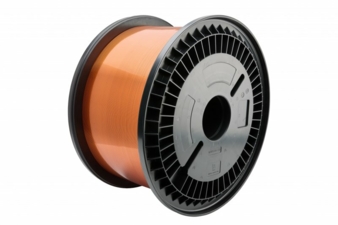
The new ribless flange geometry of the process reel “MW600-HD” reduces the loads during unwinding on under roller systems and significantly increases the spool’s usage cycles. © Häfner+Krullman
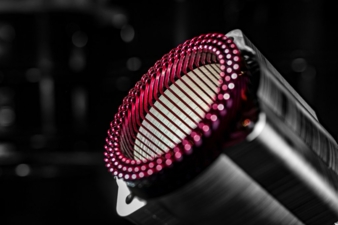
In the stator of an electric motor, U-pins made of enameled copper wire profiles are used for the winding. In production, the wire can be reliably fed onto process reel “MW600-HD” from Häfner+Krullmann. © Häfner+Krullman
In the production of electric motors, rectangular enameled copper wire profiles are used to manufacture U-pins and I-pins for the motor winding. In addition to product quality, the main requirement for wire producers is to supply wires in such a way that they can be processed reliably in production. This is where an often inconspicuous product comes into play, one that makes a decisive contribution to the wire’s processability: the spool on which the wires are wound, stored, transported, and finally unwound again.
Unwinding via under roller system
In some production facilities, the spool is not mounted for unwinding via the central bore, but rather the spool is placed on an under roller system. In some rack variants, the flange edges rest with only four contact points on two metal rollers that drive the unwinding movement. At these contact points, a high load is placed on the spools, which promotes greater wear of the material. In addition, the load can cause individual plastic particles to detach from the spools and contaminate the work area, where high cleanliness standards usually apply.
“MW600-HD”: Innovative rib structure relieves flange edges
The solution is a new rib geometry on the flange edges of the previous process reel “MW600”, developed by plastic spool specialist Häfner+Krullmann. The flange edge of the process reel “MW600-HD” is ribless, i.e., the ribs extending from the center of the flange do not reach all the way to the flange edge. This allows the edge to deform elastically under heavy loads, so that stress peaks are lower and the applied force is distributed more evenly. Particles detach much later under continuous load. Like all Häfner spools, the “MW600-HD” is also characterized by a low axial runout of the flanges and a low radial runout of the barrel.
This modified rib geometry enables higher usage cycles than previous spools with conventional flange edges. This allows wire producers to use the process reels more sustainably and economically.
Increase the service life of the spool
In principle, Häfner+Krullmann recommends using the central bore for winding and unwinding the spool. However, where under roller systems are already in use, the process reel “MW600-HD” with a ribless flange edge enables higher usage cycles, a reduction in costs, and the avoidance of quality problems due to a contaminated production environment.
The process reel “MW600-HD” at a glance
– Flange diameter d1: 600mm
– Barrel diameter d2: 400mm
– Width L1: 341mm
– Winding width L2: 280mm
Häfner+Krullmann GmbH
Kunststoff-Verarbeitungswerk
Krentruper Strasse 7-15
33818 Leopoldshöhe/Germany
Tel.: +49 5208 7004-0
info@hafner-spools.com
www.hafner-spools.com
About Häfner+Krullmann GmbH
Since its founding in 1933, Häfner+Krullmann has developed into a leading European manufacturer of plastic spools. The company’s expertise is reflected in more than 1,400 spool variants, technical parts and specialized waste containers for household and medical use, and it has played a role in the development of numerous industry standards.
More than 160 employees process over 5,000 tons of plastics annually at two sites in Leopoldshöhe, Germany. The family-owned and managed business ensures the highest quality and reliability through ISO 9001, ISO 14001 and ISO 50001 certifications, complemented by cleanroom manufacturing (Class 8) for specialized applications.