06/04/2026 – Why surface quality determines process stability and cost-effectiveness
Copper wire made from recycled material
The processing of recycled copper has become an integral part of the modern wire industry. Rising raw material prices, regulatory requirements for CO2 reduction and the growing demand for conductive materials for electro mobility, energy technology and infrastructure mean that the proportion of (so-called) secondary copper is continuously increasing.
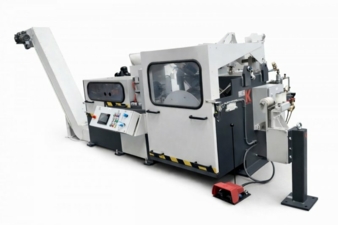
Shaving machine “HSDS 100” in single operation. © Kieselstein
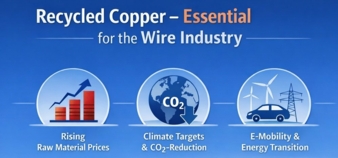
Recycled copper – essential for the wire industry. © Kieselstein
At the same time, the processing of copper scrap into high-quality drawn wire places significantly higher demands on process control and quality assurance than the processing of primary material.
While the chemical analysis of the material is often the focus of attention, industrial practice paints a different picture: it is not uncommon for process instabilities, wire breaks or increased scrap rates to occur, even though the analytical limit values are adhered to. The cause often lies not in the drawing process itself, but in the metallurgical history – in particular in the surface quality of the wire rod.
Special features of recycled copper
When processing copper scrap, the material typically goes through the following steps: sorting, preparation, smelting, refining, and continuous casting. – Alternatively, the wire can also be extracted directly, for example by separating cables from insulators. – Despite modern melting technologies, certain phenomena cannot be completely avoided. In particular, oxide zones, fine inclusions and inhomogeneous structures, known as casting skin, form at the edges of the cast wire rod. This edge zone differs metallurgically and mechanically from the core material. It often has an increased oxide concentration, non-metallic particles or microscopic structural irregularities. In recycled material in particular, trace elements such as bismuth, lead, sulphur or iron can also be locally enriched in very low concentrations. Although these elements appear to be analytically uncritical in the total volume, they have a disproportionately strong effect on the surface area. This is of crucial importance for the subsequent drawing process, because the highest mechanical stresses occur in the surface area during wire drawing. If there are inclusions or structural weaknesses there, local stress peaks occur. These lead to microcracks, premature material failure or unstable drawing conditions.
Relationship between surface and mechanical properties
The mechanical properties of copper wire – in particular tensile strength, yield strength and elongation at break – are largely determined by the degree of forming and, where applicable, by intermediate annealing. Nevertheless, the initial surface of the wire rod forms the basis for stable property development. A homogeneous, metallically clean edge area enables uniform plastic deformation during drawing. However, if the surface is disturbed by casting skin, oxide layers or inclusions, localised differences in hardening occur during forming. These can lead to uneven work hardening, surface scratches or internal stress fields. In practice, this manifests itself in fluctuating tensile forces, increased tool load and, in the worst case, wire breaks. The situation is particularly critical at high drawing speeds and high overall degrees of deformation, as is common in fine and ultra-fine wire production, for example. Here, any surface inhomogeneity has a direct impact on process stability. The consequences are reduced line speeds, frequent downtime and increased production costs.
Shaving (Draw-peeling) as a defined quality process
Against this backdrop, mechanical processing of the wire rod surface is becoming increasingly important. Controlled shaving removes the edge zone created during casting in a targeted and reproducible manner. This is not a cosmetic surface correction, but a metallurgically effective intervention in the microstructure of the material. The defined material removal removes oxides, inclusions and inhomogeneous solidification areas. What remains is a metallically bare, homogeneous edge area with clearly defined properties. This forms the ideal starting point for subsequent forming processes.
Industrial practice shows that shaved wire rod enables significantly more stable drawing conditions. The wire breakage rate decreases, the process parameters can be set reproducibly and the tool life is extended. In addition, the surface quality of the final wire is improved, which is particularly important for applications with high requirements for conductivity, platability (including silver plating) or further processing. A comparison between unshaved and shaved wire has shown that the overall deformation can be increased, thereby reducing the number of drawing stages required.
Integration into existing production lines
The shaving process can be implemented flexibly. Modern shaving machines can be integrated inline into existing drawing lines. This means that surface removal is carried out immediately before the first drawing step, without additional logistics or intermediate storage.
Alternatively, stand-alone systems can be used as an independent process stage. This is particularly useful for changing dimensions, pilot projects and targeted quality improvement of specific product groups. Depending on the total capacity, a separate drawing and shaving system can offer advantages if the wire is required for several production systems (drawing machines, rolling mills). The modular design of modern systems allows adaptation to different diameter ranges, material qualities and production speeds.
Another aspect is economic flexibility. In addition to traditional investment models, rental or usage models such as "k.rent" are becoming increasingly important. They make it possible to test new processes under real production conditions without immediately committing large amounts of capital.
Conclusion
The production of copper wire from recycled material is technically feasible and economically viable – provided that the specific metallurgical challenges are taken into account. The key factor here is controlling the edge zone. Oxides, inclusions and structural inhomogeneities inevitably occur during the casting process. If they are not removed, they have a direct impact on process stability, tool life and the mechanical properties of the wire. Controlled peeling allows this critical zone to be specifically eliminated, creating a defined starting point for drawing.
wire 2026, hall 10 booth H 18
Kieselstein International GmbH
Erzbergerstraße 3, 09116 Chemnitz/Germany
Contact person is Cristina Gómez Pardo
Tel.: +49 371 9104136
c.gomez@kieselstein.com
www.kieselstein.com