07/04/2026 – The role of wire storage systems
Automation challenges in wire cold rolling
Increasing economic pressure in wire manufacturing requires stable, efficient and increasingly automated production concepts. While upstream processes such as wire drawing are often highly automated and operated continuously, cold rolling frequently remains a limiting factor within the production chain due to its sensitivity to tensile forces and process discontinuities.
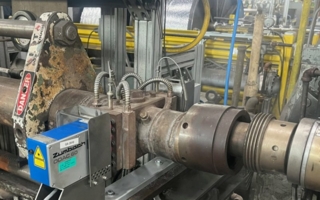
Round wire on a spool pay-off at the inlet side of a Fuhr cold rolling mill. © Fuhr
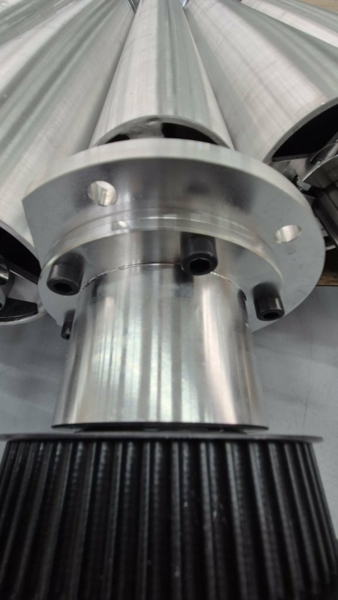
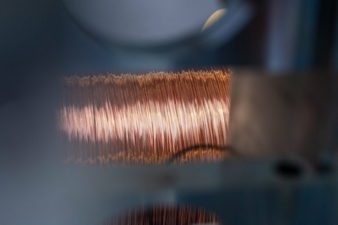
Preassembled drive parts of Fuhr’s new wire storage. © Fuhr
This article analyses the specific challenges associated with automating wire cold rolling and discusses wire storage systems as a key element for decoupling discontinuous operations. Two industrial application scenarios illustrate when and why such systems become necessary. The wire storage system is presented as an enabling component within a broader process architecture aimed at continuous and robust wire production.
Wire manufacturing is characterised by stringent requirements regarding dimensional accuracy, surface quality and process stability. At the same time, manufacturers face increasing pressure to improve productivity and reduce operating costs. Automation is widely regarded as a necessary strategy to maintain competitiveness, particularly in cost-sensitive manufacturing environments and high-wage regions.
However, the degree of automation varies considerably across different process steps. Wire drawing lines, for example, frequently operate at high levels of automation with continuous material flow. In contrast, cold rolling operations often involve manual interventions, speed reductions or temporary process interruptions. As a result, cold rolling can become the limiting element when attempting to implement continuous production concepts.
Understanding the specific challenges of wire cold rolling is therefore essential when aiming to increase automation levels in the overall production line.
Wire cold rolling differs from many other metal forming processes due to the small cross-sectional dimensions involved and the strong interaction between tensile force and forming result. Even minor fluctuations in tensile force can influence geometry, profile accuracy and surface condition.
In many industrial installations, cold rolling is integrated into production lines that include discontinuous operations such as coil changes, inspection procedures or handling steps. These interruptions lead to non-steady-state conditions that directly affect rolling stability.
From an automation perspective, the core challenge is therefore not solely the rolling stand itself but the lack of temporal decoupling between process stages. Without such decoupling, disturbances propagate through the entire line, limiting the achievable level of automation and robustness.
Wire storage systems become necessary whenever a continuous forming process should not, or must not, be interrupted.
Maintaining continuous rolling during coil changes
Modern cold rolling lines for wire can operate at speeds of up to approximately 1,000m/min. In conventional setups, a coil change at the take-up unit requires stopping the line. This interruption introduces non-steady-state conditions that may negatively affect dimensional accuracy and surface quality of the final product.
To minimise such disturbances, operators often reduce line speed significantly during coil changes, for example to approximately 30 m/min. Although production technically remains continuous, overall productivity is substantially reduced.
By integrating a wire storage system, the rolling process can continue at high speed while the coil change is performed independently. The temporarily stored wire length compensates for the interruption at the take-up unit and prevents tensile force fluctuations from directly influencing the rolling stand. As a result, stable process conditions can be maintained without reducing productivity to a minimum level.
Decoupling upstream or downstream continuous processes:
A second relevant scenario arises when upstream or downstream processes require uninterrupted wire feed for technological reasons. Certain production steps cannot be stopped without compromising process integrity or product quality.
Without a wire storage system, any interruption in the rolling process would force a shutdown of the entire production chain. The storage system acts as a buffer, allowing temporary decoupling of process stages and preventing disturbances from propagating across the line.
In addition, the need for manual coil change operations can be reduced. In conventional lines, manual coil replacement requires stopping the system. Alternatively, highly automated coil-changing systems would be necessary, involving considerable technical and economic complexity. A wire storage system provides a comparatively robust and pragmatic solution, particularly in existing installations.
The described application scenarios demonstrate that wire storage systems are not merely auxiliary components but structural elements within process architecture. By stabilising tensile conditions and isolating discontinuities, they create favourable boundary conditions for further automation measures.
Rather than attempting to compensate for instability solely through increasingly complex control algorithms, the integration of a storage system addresses the root cause of process variability. Once the cold rolling stand operates under more stable tensile conditions, additional automation strategies – such as adaptive control, inline measurement integration or operator-independent process management – can be implemented more reliably.
From a practical standpoint, the integration of a wire storage system also supports incremental modernisation. Existing lines can be upgraded step by step without requiring complete replacement. This approach reduces investment risk while increasing operational stability and automation potential.
Automating wire cold rolling requires more than advanced control technology; it demands a reconsideration of overall process architecture. The presented application scenarios illustrate that wire storage systems provide a robust and practical means of decoupling discontinuous operations and stabilising rolling conditions.
By enabling continuous operation during coil changes and by isolating upstream or downstream disturbances, wire storage systems address both productivity and quality aspects. They represent a key enabling component on the path toward continuous and automated wire production.
Fuhr is currently developing integrated solutions aimed at implementing wire storage systems within both existing and new rolling lines in order to further stabilise and expand continuous production concepts.
wire 2026, hall 9 booth F 40
Fuhr GmbH+Co. KG
Ottenhausener Strasse 49
32839 Steinheim/Germany
Contact person is Esther Klinge
Tel.: +49 5233 38360-42
esther.klinge@fuhr-wire.com
www.fuhr-wire.com