24/03/2026 – Quality management
Towards a new paradigm in the finishing area of long rolled products
The most significant movement in today´s industry is the incorporation of artificial intelligence to optimise processes and improve product quality. This brings with it trends such as big data management and sensor integration (IoT) among others. This presents new challenges for professionals in the steel sector.
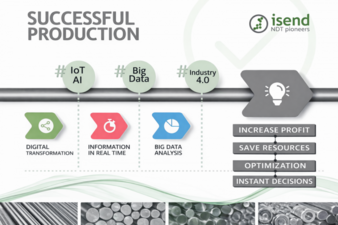
© Isend
The most important being the need to ask the right questions. In other words, to be very clear about the objective being pursued and the information that is needed. Users do not seek an endless array of sensors managed independently; they want meaningful insights delivered with minimal complexity.
The finishing area of rolling mills is an ideal place to obtain intelligent information, but this is only possible with logical integration of sensors and actuators, and not with the high dispersion and lack of integration that currently exists.
To solve this issue, a new generation of equipment has emerged in recent years and is now a reality. This equipment is multi-purpose, capable of detecting defects in real time, measuring product dimensions and even obtaining material properties such as hardness. Following the acquisition of the information, artificial intelligence can then be applied to improve products and services in ways never seen before.
A great example of this new generation of equipment is the new “Eddy Eyes Pro” from Isend, which, in a very short space, allows the use of different technologies, the best for each purpose, in a precise, reliable and real-time manner. This system uses eddy current sensors for defect detection and mass flow measurement, artificial vision systems for instant identification and classification of defects, a high-performance profilometer and, in future versions, a metallographic property meter.
“Eddy Eyes Pro” captures the essence of the transition towards a digital rolling mill providing the users with accurate, real-time data of multiple variables. This data can be connected to other elements of the rolling mill, L2 or MES for example ultimately enabling users to build a “digital twin” of the rolling mill.
wire 2026, hall 6 booth A 02
Isend, S.A.
Ingeniería y Sistemas de Ensayos No Destructivos, S.A.
P.T. de Boecillo, C/ Luis Proust N 10
47151 Boecillo, Valladolid/Spain
Tel.: +34 983 132307
contact@isend.es
www.isend.es